Your community's cloud, run together
How KolliCloud and the Co-op Cloud Federation are making it feasible for small communities to own and share sovereign digital infrastructure — affordably, sustainably, and without a DevOps team.
Most communities that want to leave Big Tech hit the same wall. The tools exist. The values are right. But someone has to install everything, keep it updated, wire the login together across a dozen apps, and be on call when something breaks — and for a volunteer-run association or a small collective, that someone usually does not exist.
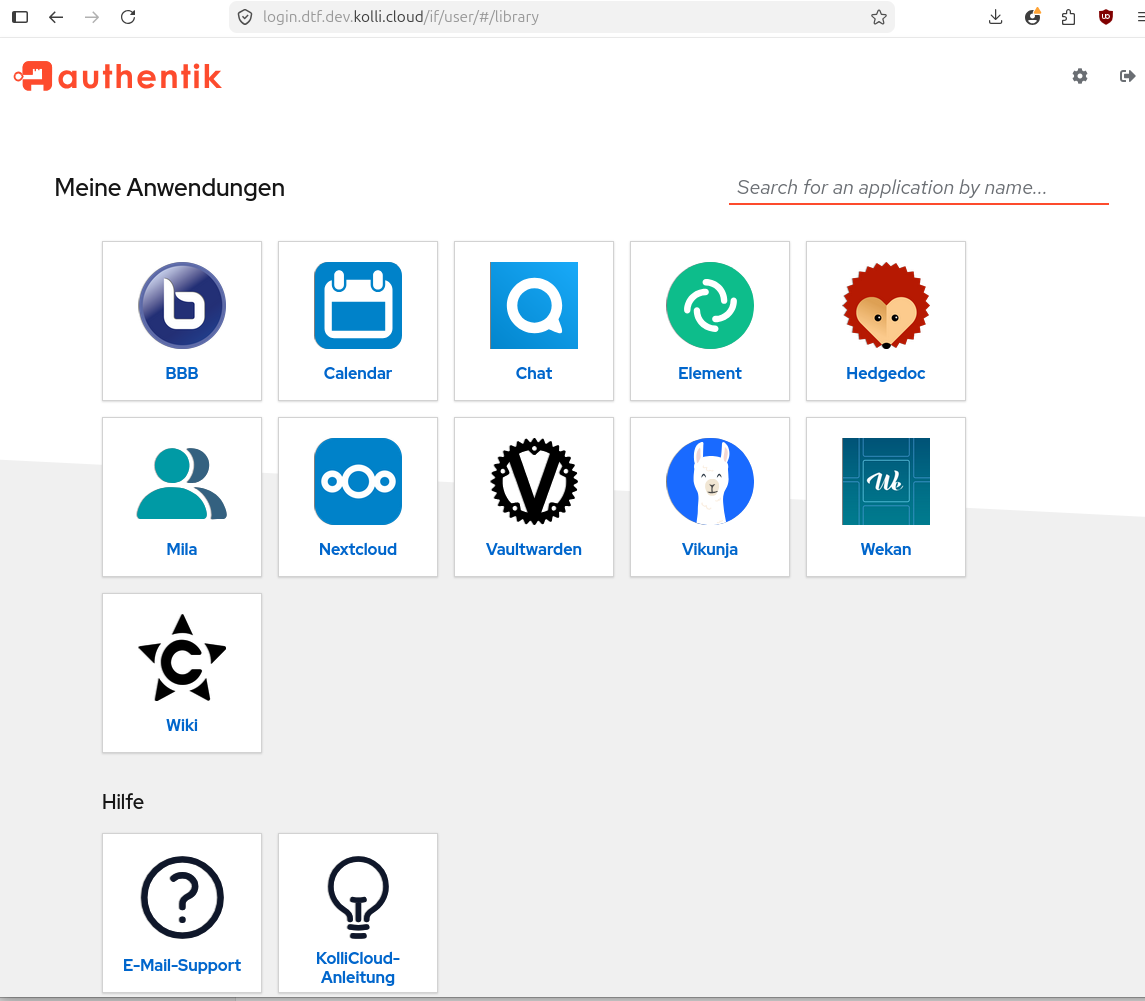
KolliCloud answers that question directly. It is a complete, ready-to-use collaborative workspace built specifically for clubs, NGOs, and community organisations — one login, fifteen apps, backups and monitoring included from day one. And because it is built on a shared configuration commons maintained collectively by the Co-op Cloud Federation, the hosting work that would overwhelm a single organisation becomes manageable when it is spread across a community of operators.
This is why we are featuring KolliCloud as a Democratic Tech Fund case: it is one of the most concrete demonstrations we have seen of how cooperative infrastructure logic — shared code, shared operations, shared governance — makes sovereign digital tools genuinely accessible to communities that would otherwise have no realistic alternative to Google or Microsoft.
What you actually get
Behind a single sign-on, KolliCloud gives a community organisation:
Files and collaboration: Nextcloud for file storage and sharing, OnlyOffice for co-editing documents and spreadsheets, Hedgedoc for collaborative notes.
Communication: Element/Matrix for encrypted team chat — federated, so you can communicate with other Matrix users outside your organisation.
Task and project management: Wekan (Kanban boards) and Vikunja (task lists and project tracking).
Security and access: Authentik as the single sign-on identity provider, Vaultwarden for shared password management.
Publishing and support: WordPress for websites, Zammad for ticketing and support queues.
The full bundle runs to around fifteen applications, all integrated through Authentik so members log in once and reach everything. Backups are automated, monitoring is wired in, and the whole stack sits on free software: no licence fees, no vendor lock-in, no data leaving your jurisdiction.
How a shared commons makes this affordable
KolliCloud is built by Local-IT e.V., a small German non-profit association with 35 members and six part-time positions. Local-IT could not have built this alone — not because of a lack of skill, but because maintaining fifteen integrated applications across dozens of community instances is genuinely hard work. What makes it possible is that Local-IT does not maintain those applications from scratch. They build on the Co-op Cloud Federation’s configuration commons.
Co-op Cloud is a federation of hosting cooperatives, NGOs, and individuals governed collectively, with Local-IT and the Democratic Tech Fund among its members. Its core contribution is a library of community-maintained deployment recipes — standardised, tested configurations for hundreds of free-software applications — and a command-line tool called abra that deploys them onto servers reliably and repeatably. When a Co-op Cloud recipe is updated, every operator using it benefits. The maintenance work is shared across the federation rather than duplicated by each provider independently.
On top of this commons, Local-IT built Alakazam, a meta-configuration layer that solves the problem Co-op Cloud itself does not fully address: how do you manage dozens of .env files across many instances without it becoming a full-time job? Alakazam uses hierarchical YAML configuration with inheritance, so shared defaults are defined once and each instance only specifies what differs. It manages secrets, wires together the integrations between apps (SSO configuration in particular), and enables batch updates across all instances with a single command. Local-IT used it to update over 200 deployed applications in a few hours. In 2026, the Co-op Cloud Federation formally adopted Alakazam as an official federation project — a recognition that the methodology Local-IT developed belongs to the commons.
The practical result: a new KolliCloud instance — server, all applications, SSO, backups, monitoring — takes under thirty minutes to deploy. Monthly maintenance is dominated by application upgrades, and because those upgrades are tested centrally and then rolled out across all instances together, the effort scales with the number of applications, not the number of instances. Adding a new community to the hosting cluster adds almost no marginal work.
The communities already running on it
KolliCloud’s users are not early adopters experimenting with self-hosting. They are real organisations with real needs and no IT department.
QueerSupport.de, Germany’s largest queer youth support organisation, migrated their entire operation onto KolliCloud. Their support service, through which young queer people reach out for help, runs on Zammad, integrated with Matrix/Element and a Signal bridge, so volunteers respond to support requests directly from their chat client. Valentin from the organisation described it plainly: “KolliCloud solved the hosting problem for a small, financially constrained org.”
FLINTA* communities — organisations centred on women, lesbian, intersex, non-binary, trans, and agender people — are among KolliCloud’s growing user base, drawn by the combination of data sovereignty (no data on US-controlled infrastructure), cooperative values alignment, and the practical ability to get a complete digital workspace without technical expertise.
A volunteer fire brigade. A rural civic network. Associations with a hundred members and zero budget for commercial software. This is who KolliCloud is for — and this is who benefits most concretely when the alternative to Big Tech is not just theoretically possible but practically deployable in half an hour.
Collective hosting: sharing the work, spreading the resilience
The model Local-IT has developed does not require a single centralised provider. It is designed to distribute hosting responsibility across a cluster of community administrators — what they call collective hosting, applying the Co-op Cloud commons logic one layer further down, at the infrastructure level.
Currently seven organisations share hosting responsibility across seven instances on a common framework. Multiple administrators hold access to the same infrastructure, which means mutual cover: if one administrator is unavailable, others can step in. When eCommons Amsterdam set up a KolliCloud instance independently, using Local-IT’s public configuration repositories without any direct involvement, Local-IT celebrated it: “That’s the kind of momentum we want.”
The economic logic is equally important. Local-IT’s managed hosting runs at €20–€200 per month per instance, averaging around €60. The collective hosting model means that infrastructure costs are shared across participating organisations — and that the administrative labour is, too. What would be unaffordable or unsustainable for a single small community becomes viable when the work is carried collectively.
Built on commons, built to spread
Local-IT has received around €540,000 in public and civic funding since 2021 — from Germany’s DSEE (Deutsche Stiftung für Engagement und Ehrenamt), the Akademie für die ländlichen Räume, Kreis Ostholstein, and others — to develop KolliCloud and the broader toolchain. Every component of that work is open: the deployment configurations are public, the Alakazam orchestration tool is a Co-op Cloud commons project, and the documentation is available for anyone to pick up.
This matters because the question the Democratic Tech Fund cares about is not whether KolliCloud exists — it does — but whether the model can spread. Can an association in Catalonia, a cooperative network in the Netherlands, or a community radio constellation in Ireland run something equivalent? The answer is increasingly yes: the technical commons is there, the methodology is documented, and the Co-op Cloud Federation provides the community of operators to draw on.
The shift this enables is not just technical. As Simon from Local-IT put it during our community call: the work moves from DevOps towards community support. Once the infrastructure is running reliably, what organisations need is not more system administration: it is onboarding, training, governance design, and the social care that makes a shared tool actually used. That is work communities know how to do.
What we want this to inspire
We are featuring KolliCloud because we think it represents a pattern worth replicating — not just the software stack, but the organisational logic: a non-profit association, embedded in a cooperative federation, building shared infrastructure for the communities around it, on top of a commons that grows stronger the more people contribute to it.
If you are part of a community organisation, cooperative, or civic network that is looking to move off Big Tech tools, or if you can see the shape of a KolliCloud-style hosting cluster emerging in your own context, we want to help you build the case for it.
The Democratic Tech Fund exists to do this collectively: mapping what already exists, connecting communities with operators and tools, and mobilising funding — seed support, crowdfunding, public-private match funding — to make sovereign digital infrastructure real for communities that need it. We work alongside Co-op Cloud, Local-IT, Commons Network, eCommons, Waag, Goteo, and others who share this commitment.
Tell us what your community needs, what already exists near you, and what a cooperative infrastructure model could look like where you are.
Get in touch with the Democratic Tech Fund → Support this work via Open Collective →
This story draws on our community call with KolliCloud and Local-IT e.V., hosted by the Free Knowledge Institute with the Democratic Tech Fund and the Co-op Cloud Federation on 21 May 2026. Read the full session report on the FKI website → and explore the project at kollicloud.de, coopcloud.tech, and local-it.org.
When more organisations join, the apps multiply — the maintenance doesn't. That's the whole point of a configuration commons.